
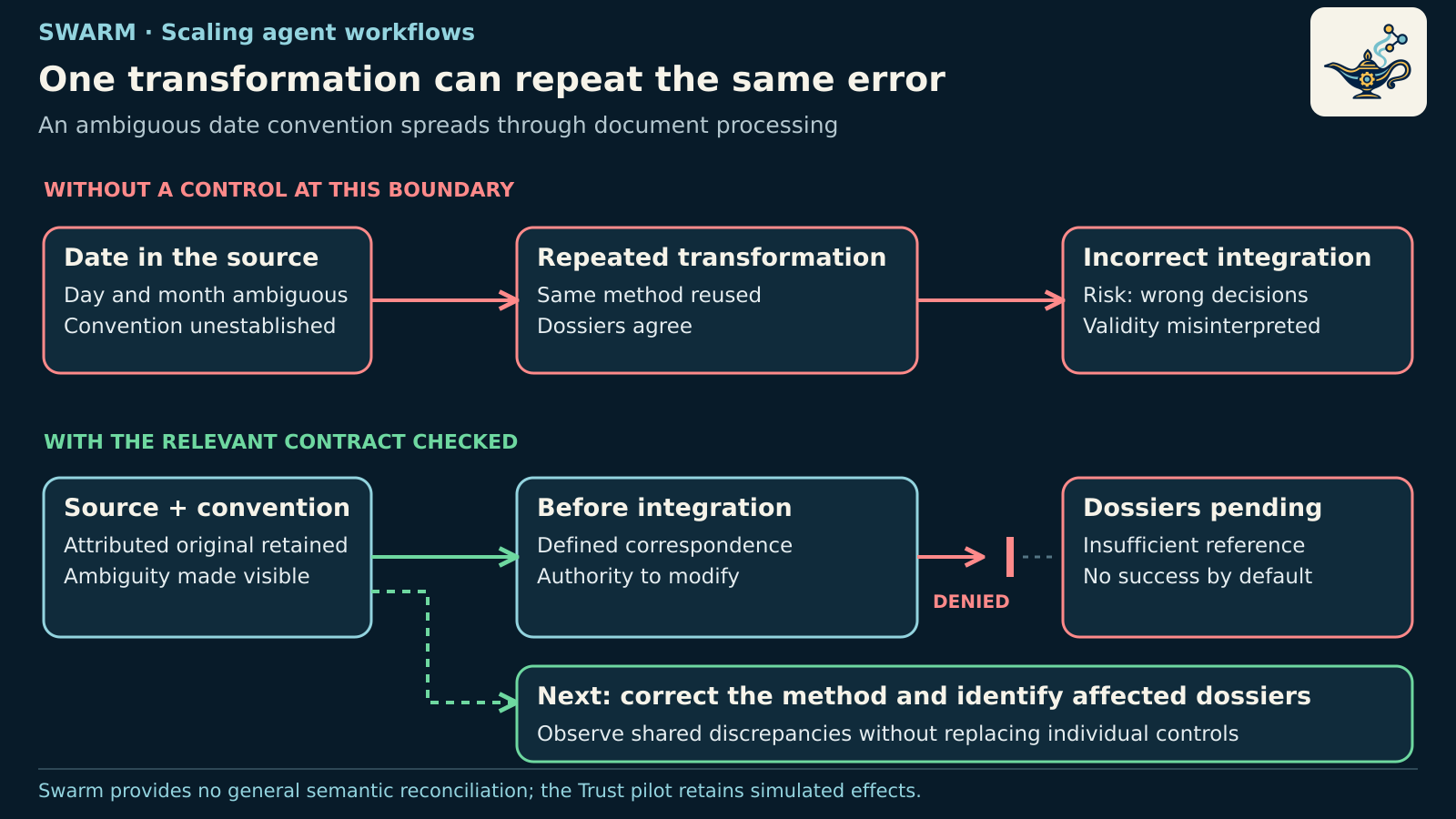
An agent can make an error in one dossier. A reused workflow can reproduce the same error across many dossiers before its owners recognise it. Scaling increases the importance of shared sources, transformation rules and recovery decisions.
Agent count alone does not describe this risk. Several agents may share the same model, method or incorrect source. Agreement between their answers then provides no independent confirmation.
One date becomes wrong across several dossiers
Consider document processing that extracts an expiry date and prepares its entry into a business system. The document uses a date format in which day and month can be confused. The agent normalises it using the wrong convention. The dossier remains readable and its output format passes validation.
Reusing that mechanism across a batch could cause documents to be treated as still valid or already expired when they are not. A later stage might accept an incomplete dossier, request an unnecessary document or suspend legitimate processing. Impact depends on the business use, not just document count.
A second agent cannot resolve the issue if it sees only the normalised value or applies the same convention. Verification needs a relevant reference: the original document, attributed field, applicable convention and rules for ambiguous cases.
Agreement between agents does not establish independent sources. Repeated transformation can make an error consistent rather than visible.
Check the dossier and observe the population
Two functions complement each other. At integration, a control checks the conditions for this dossier: value origin, a defined correspondence with the source, expected format and authority for the operation. Alongside it, supervision can track anomalies, corrections and method versions across dossiers.
Collective observation can help identify a common problem. It does not automatically establish whether a date is true. A stable rate can conceal systematic error; an alert rate needs a denominator and a defined measurement method. Cases without a reference should remain unresolved rather than count as successes.
The OWASP AI Agent Security Cheat Sheet recommends agent trust boundaries and checks on their communications. This does not replace data qualification or protection of execution components.
Organise human intervention around decisions
Workload cannot be solved by choosing between approving everything and allowing everything. An organisation must distinguish operations requiring explicit approval, preparation that can continue without a sensitive effect, and cases that must remain pending. The choice depends on consequences, permissions and applicable process obligations.
For the date example, extraction can produce a proposal while retaining the ambiguity. Changing the official dossier requires the conditions defined for that operation. Later statistical analysis does not justify removing a required pre-effect approval.
Consumption, concurrency and recovery limits also need an explicit policy. Repeating attempts against the same ambiguity can add cost without information. Useful recovery changes a precondition: finding the reference, establishing the date convention or obtaining the authorised decision.
Trace propagation after a correction
Correcting the detected dossier does not treat other outputs of the same method. Investigation needs shared versions and sources, affected dossiers and effects already committed. A new version must not silently rewrite historical results.
Recovery can introduce another risk. Reissuing an operation whose outcome is unknown can produce a second effect. The process must distinguish data correction, new commitment and reconciliation of an uncertain outcome. An idempotency key neither corrects a false date nor erases an applied decision.
Swarm’s scope
Swarm organises tasks, responsibilities, controls and recovery. Its Rust contracts examine correspondence between validation evidence, an attempt, a policy and declared artefacts. The Trust pilot retains actions and effect states in a simulated domain.
These mechanisms are neither a production customer-due-diligence service nor general statistical detection of errors across an agent population. Universal document reconciliation, a globally immutable audit trail and confinement of every access path are not established by the engine alone.
The Swarm repository exposes these boundaries. The aim is to retain a justified decision for every sensitive effect while making a shared cause across multiple dossiers identifiable and treatable.