
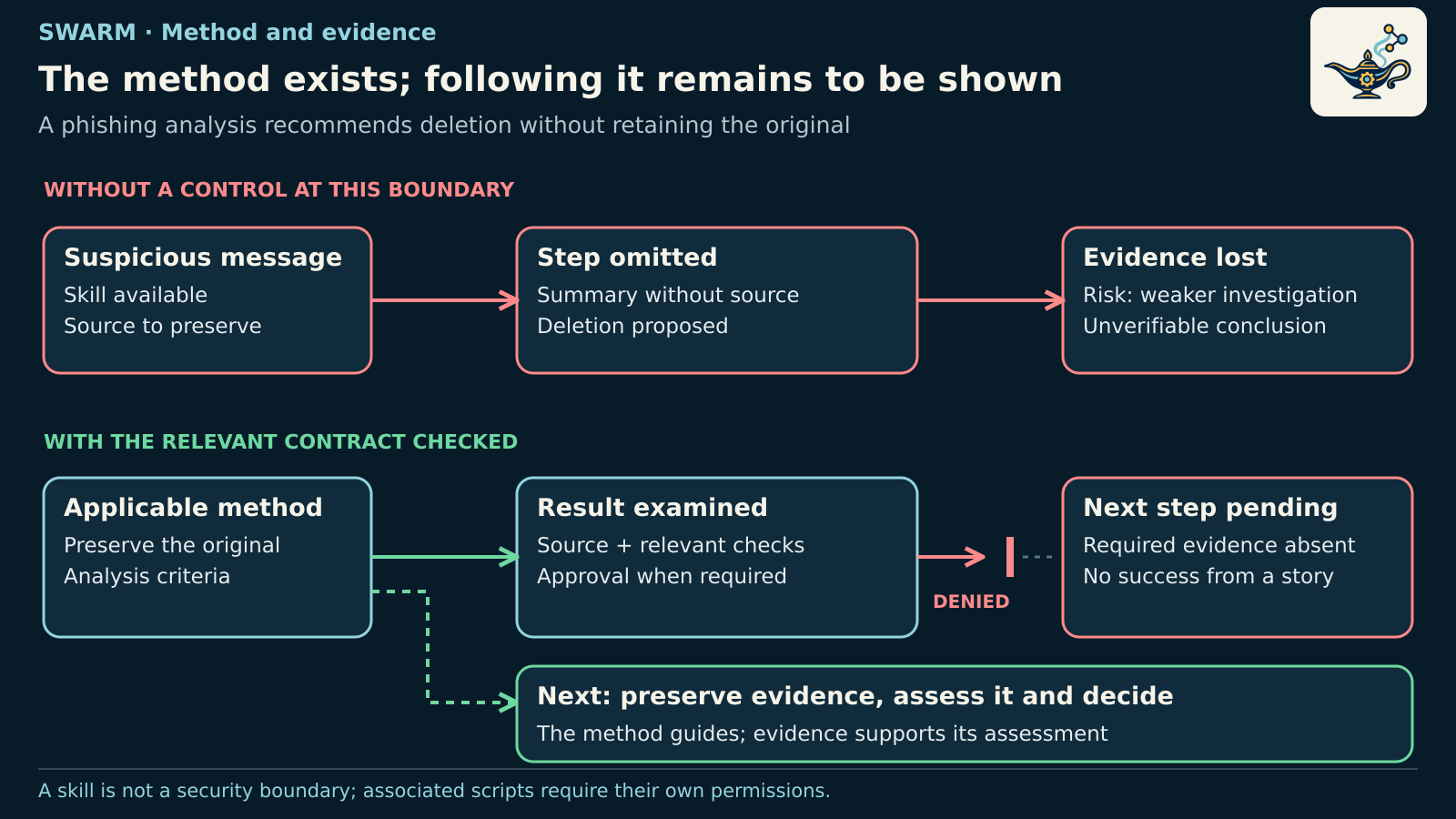
An on-call analyst receives a phishing alert. The agent has a method requiring preservation of the original message, examination of headers and separation of indicators from conclusions. It nevertheless produces a summary without retaining the original, then proposes deletion. Following that proposal could deprive the team of evidence needed to reconstruct the message’s route and support its investigation.
The procedure existed. What is missing is evidence that it was applied to this case. That distinction explains both the value and the limit of skills: making a method available does not create an execution rule that cannot be bypassed.
What I call level 3
In my maturity framework for AI use, level 2 defines the work environment. Level 3 describes a reusable method: when to use it, what information to request, which steps to follow, what to deliver and when to seek a decision. This personal framework is not a certification standard.
A skill can package instructions, references and scripts. Anthropic’s Agent Skills format organises those resources through progressive loading: an entry point supports discovery, with details consulted as needed. It helps transfer expertise without injecting everything into every request.
A method, an application workflow and a tool call are nevertheless different objects. Their consumers, permissions and execution conditions need separate examination.
The SOC protocol and its missing evidence
The method should identify the original to preserve, permitted transformations, enrichment sources and the information required before deletion. A persuasive report is insufficient: the analyst needs to recover its supporting elements and understand the remaining uncertainty.
A method describes the expected work; evidence allows examination of what actually happened.
If a required source is missing, the next step remains pending. The agent’s justification cannot reconstruct lost data. Analysis may continue using available material, retaining the limitation in its conclusion.
The skill can structure this work and help reduce specified omissions. It eliminates neither variation between agents nor incorrect conclusions. An obsolete or unsuitable protocol can instead reproduce the same error across many cases.
A library needs governance
Each method needs a scope, owner, conditions of use and a way to assess its output. Changes in tooling or obligations can invalidate a step. Conflicting methods require an explicit decision, rather than silent selection of the most persuasive wording.
Associated scripts also engage real capabilities. Packaging a script in a skill grants no additional authority to read sensitive data, call a service or modify a resource. Its origin, content and effects require the same scrutiny as other executable components.
RAG follows the same logic. A method can select corpora and define retrieval criteria. A similarity threshold has no universal value: it depends on the model, corpus and task. It establishes neither the truth of a passage nor permission to use it.
Where Swarm fits
Swarm distinguishes methods that guide work from controls that qualify transitions. Its catalogue describes planning, implementation, diagnosis and verification methods. A preparation method proposes a plan; it does not automatically grant authority to launch or accept agents.
Rust validation mechanisms bind control observations to their operation and expected elements. A method file’s presence does not become evidence that all its steps ran. The relevant checks must be defined and connected to the affected execution path.
Level 4 examines that connection: which event triggers a check, which decision it can block and what happens when it fails. The Swarm repository makes those contracts distinguishable from written advice alone.
Further reading: LLM anatomy: foundations; model weights, attention and cybersecurity.